3D-Printed Judaica, Food and Flames: What Not to Assume
By Jewish 3D Prints · Updated
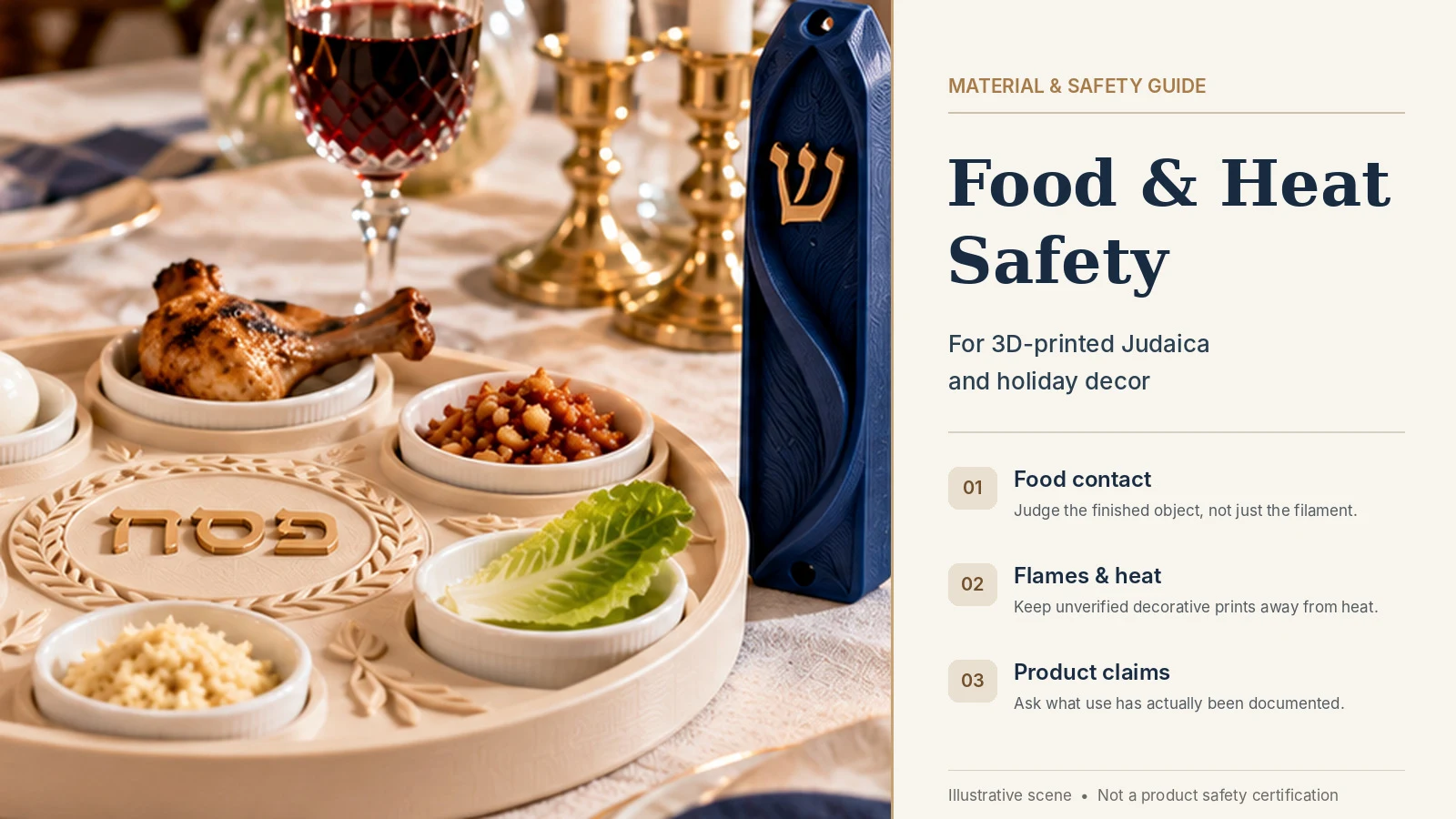
Jewish table and holiday objects can sit near food, candles, hot wax or liquids. That context makes safety information important even when an object is primarily decorative. A printed surface's appearance does not establish whether it belongs in contact with those things.
Filament is only one part of food-contact suitability
Prusa's food-safe FDM guidance explains that assessing a finished print involves more than whether a base polymer is described as chemically neutral. Pigments and additives can vary. Equipment and post-processing matter. Surface grooves can make cleaning more difficult.
Do not treat a filament label, a seller's decorative photograph or the absence of a visible coating as proof that a finished object is suitable for food. A specific product must have documented suitability for its actual intended use.
Decorative organizers and food dishes are different
A table organizer may hold separately manufactured, suitable dishes without its printed surface touching the food. That is a different arrangement from using a print as the dish itself. Any insert or liner needs its own material, stability and cleaning assessment; adding one does not automatically validate the whole assembly.
For Passover use, material safety and religious preparation requirements are separate. Ask your rabbi about the latter rather than treating a decorative design as an assurance of religious suitability.
Open flames need purpose-designed equipment
Ordinary printed-plastic decorative objects should not be placed against candles, flames, hot wax or other heat sources. A menorah-shaped ornament is not automatically a functional Hanukkah menorah. A decorative tray is not automatically a safe candle stand.
Use equipment specifically designed and documented for the heat and flame exposure involved. Follow its instructions for positioning and clearance. Do not assume that a metal insert makes an otherwise untested printed assembly safe.
Avoid general labels that promise too much
Words such as “eco-friendly,” “food safe,” “waterproof” or “heat resistant” should refer to supported characteristics of the actual finished product, not guesses from its manufacturing method. Biodegradability claims also need context and evidence; they are not a reason to disregard care or disposal guidance.
A safer buying conversation
Explain your intended use precisely: decorative display, storage, direct food contact, carrying something warm or use near candles. Ask what is documented for the finished item and what is explicitly excluded.
Our current demo objects have not been reviewed as food-contact or heat-exposed equipment. Explore Shabbat décor, Hanukkah designs and Passover planning as separate design categories—not as safety certifications.
Sources and further reading
- Caring for 3D-Printed Judaica: A Cautious Decorative-Item Guide
Understand layer lines, cleaning limits and why product-specific material guidance matters more than generic care advice.
- Passover Table Accessories: Separate Meaning, Fit and Food Safety
Plan decorative Seder-table accessories without confusing a symbolic design with food-contact suitability or Passover approval.