How to Choose a Mezuzah Case: Scroll Fit, Materials and Placement
By Jewish 3D Prints · Updated
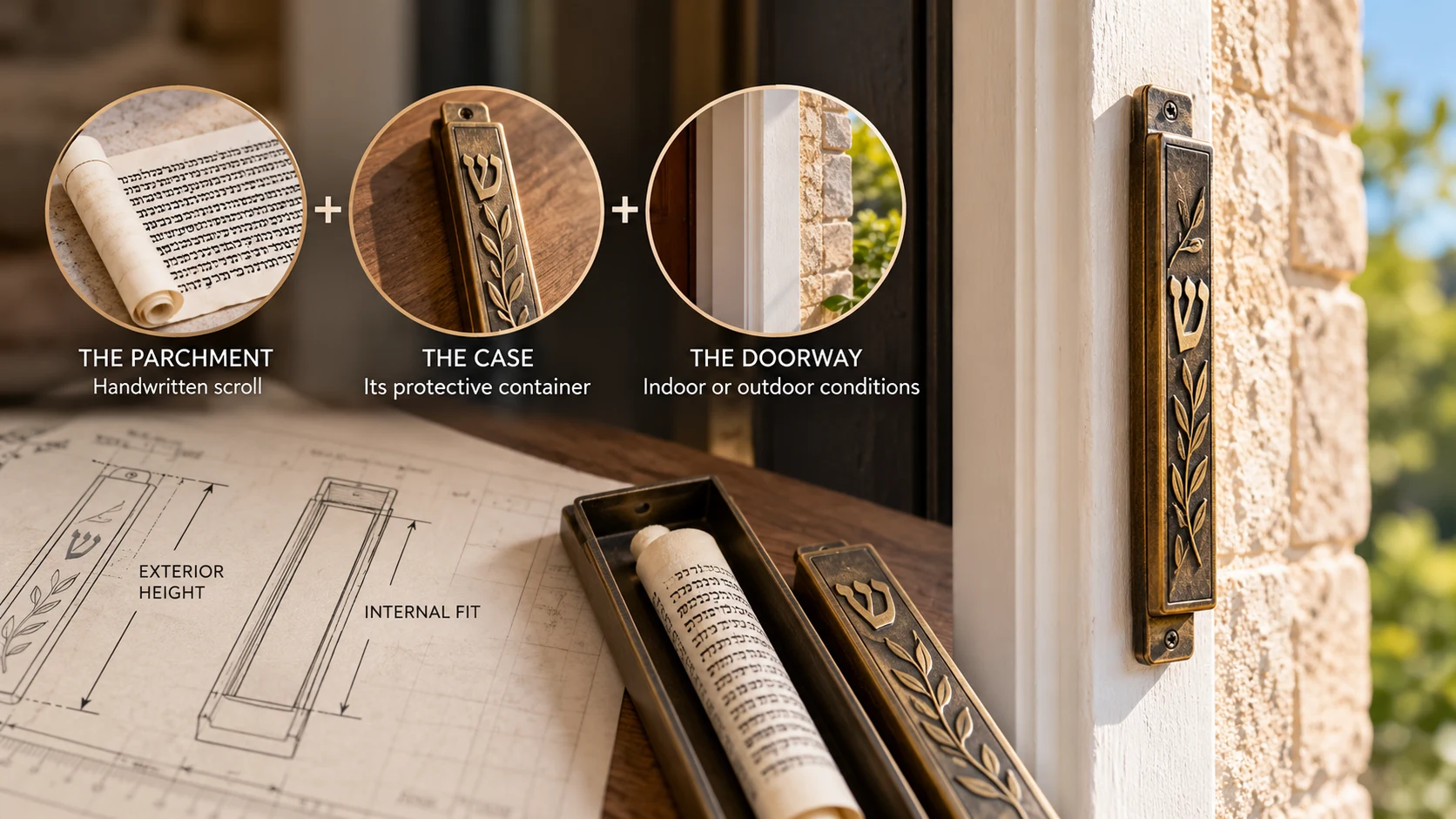
A mezuzah case can be a small design detail with considerable meaning. Yet choosing one is not only a question of color or style. The most useful first step is to separate three decisions: the kosher parchment, the case that will hold it, and the conditions at the doorway.
The case does not replace the scroll
In everyday shopping language, “mezuzah” sometimes refers to the whole object on a doorpost. For purchasing, the distinction matters: the parchment is the handwritten scroll; the visible case is its container. Decorative Hebrew lettering on a case does not turn it into a kosher parchment. Religious suitability depends on requirements for the scroll, not simply on the case's appearance.
Look for a clear statement of what a listing includes. A case-only price should not be read as a case-and-scroll bundle. If you already have a scroll, you may only need a compatible case. If not, discuss the appropriate parchment with a qualified sofer or your rabbi rather than choosing solely by the decorative design.
Check internal fit, not just exterior height
Cases have walls, closures and sometimes hardware that reduce the usable interior. An exterior measurement therefore does not establish which scroll fits. Start with the parchment size, compare it with the stated supported scroll size and internal space, and account for its usual protective wrapping.
Do not press a scroll into a case that is too tight or assume that a taller case supports every smaller scroll. Ask for clarification when the product information only gives outside dimensions. This is especially important with a custom printed case, where an attractive concept image is not a measured production sample.
Treat outdoor placement as a separate requirement
An interior doorway and a weather-exposed entry create different demands. Rain, moisture and changing conditions can affect the container and its contents. A seam, lid or enclosed shape is not proof of waterproofing.
For an exterior setting, ask whether the finished design has documented outdoor suitability. Clarify its mounting method, closure and maintenance requirements. Never infer weather resistance from the phrase “3D printed,” or from the general name of a plastic.
Confirm the mounting method
Check whether the case is designed for screws, adhesive or another specified method. Then consider the doorframe material and the manufacturer's instructions. Hardware inclusion should be explicit. Placement, angle and blessings are matters of religious practice; this design guide is not a ruling on them.
Before you choose
- Is the product a case only, or does it explicitly include a parchment?
- What scroll size and wrapping fit inside?
- Is its intended location indoors or outdoors?
- What mounting method and hardware does it require?
- Are its materials and care instructions documented?
Explore mezuzah cases and our mezuzah FAQs. The current catalog contains labeled demo designs, not verified products for sale.
Sources and further reading
- 3D-Printed Judaica, Food and Flames: What Not to Assume
Separate decorative use from food-contact and heat safety when considering Shabbat, Hanukkah or Passover accessories.
- Choosing Personalized Judaica Gifts: A Pre-Order Checklist
Choose a meaningful gift by checking the recipient's needs, ritual requirements, Hebrew spelling and the difference between a request and an order.